
Evidence checked July 25, 2026 (UTC). This FLUX 3 complete guide explains what Black Forest Labs has actually announced, what is available now, and what remains on the roadmap. FLUX 3 is a unified multimodal foundation model trained across images, video, and audio, with related work in action prediction. FLUX 3 Video is in limited Early Access and can generate clips up to 20 seconds with native audio. FLUX 3 Image has been demonstrated, but Black Forest Labs says its Early Access phase will open in the following weeks. Public pricing, stable model IDs, general API documentation, and open weights have not been released. Veemo AI does not currently offer a verified FLUX 3 generation route.
FLUX 3 release status at a glance
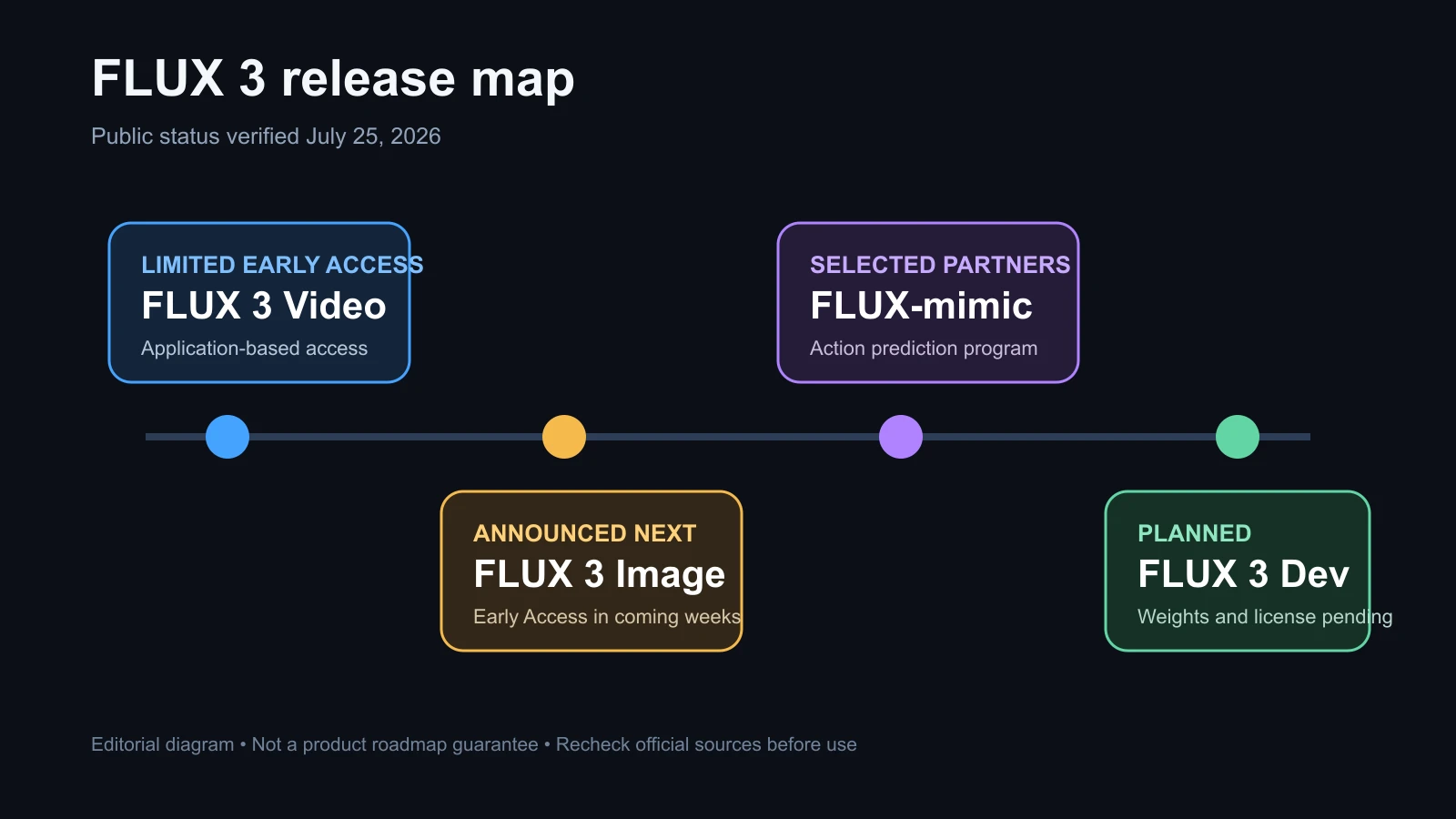
The most important distinction in this FLUX 3 complete guide is the difference between a model-family announcement and a generally available product. Black Forest Labs announced FLUX 3 on July 23, 2026 and described it as available in Early Access. Its own launch post then separates the rollout by capability. Video access is open through an application-based Early Access program. Image Early Access is planned for the following weeks. Action work is limited to selected research and commercial partners, while open-weight access is part of a future launch plan.
| Capability | Current public status | What is confirmed | What is not yet public |
|---|---|---|---|
| FLUX 3 Video | Limited Early Access | Text-to-video, image-to-video, video-to-video, video/audio continuation, keyframes, native audio, and clips up to 20 seconds | General API availability, public price, stable endpoint, throughput, and service limits |
| FLUX 3 Image | Early Access announced for coming weeks | Image synthesis and editing previews, multiple styles and resolutions, improved prompt and multilingual text handling claimed by BFL | A public launch date, price, endpoint, output limits, and generally available product access |
| FLUX 3 Action / FLUX-mimic | Selected partners | Action prediction work with mimic robotics and testing/deployment work involving Audi | A general creator product, public action API, or self-service access |
| FLUX 3 Dev | Planned | BFL says it intends to release an open-weight multimodal backbone | Weights, license, hardware requirements, release date, and reference inference code |
This status table prevents three common errors. First, “Early Access” does not mean every account can use the model. The program terms describe access as limited, revocable, capacity-managed, and potentially delivered in batches. Second, the existence of image examples does not mean FLUX 3 Image is already open. The launch post explicitly says its Early Access phase will follow. Third, a planned open-weight edition is not the same thing as downloadable weights under a known license. Until BFL publishes the files and terms, local deployment claims are speculation.
What makes FLUX 3 different from FLUX.2?
FLUX.2 is a production image-generation and image-editing family. FLUX 3 changes the scope: Black Forest Labs describes one foundation model that jointly learns from images, video, and audio. The company argues that spatial appearance, motion over time, and sound caused by physical events are different observations of the same world. Training them together is intended to produce a representation that connects how something looks, moves, and sounds instead of treating each medium as an isolated pipeline.
That architectural direction matters more than a version-number comparison. This FLUX 3 complete guide does not describe the model as simply “FLUX.2 with better image quality,” and the current evidence does not support a conventional side-by-side scorecard. FLUX.2 has documented image endpoints, megapixel-based prices, model variants, and reproducibility guidance. FLUX 3 is an emerging multimodal family with preliminary evaluations and limited access. Buyers should compare production readiness separately from capability ambition.
The official launch post links FLUX 3 to Self-Flow, an approach intended to align multimodal generation and understanding efficiently within one architecture. BFL says it scaled training across image, video, and audio at the same time. It has not yet published the full FLUX 3 technical report, parameter count, training corpus, inference requirements, or independent benchmark package. A responsible FLUX 3 complete guide therefore treats the architectural explanation as vendor positioning until reproducible technical evidence becomes available.
FLUX 3 Video capabilities and limits
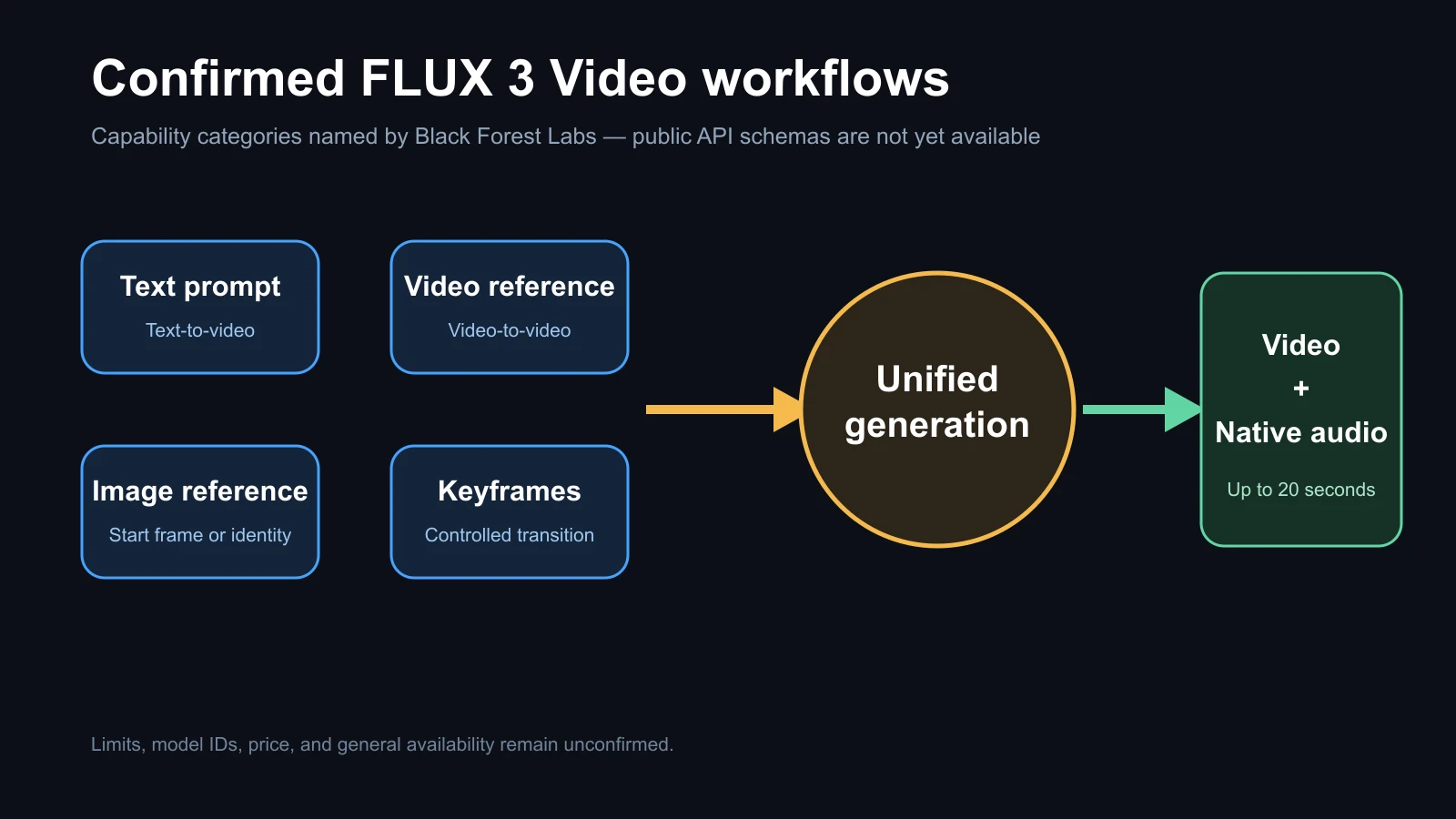
In this FLUX 3 complete guide, Video is the most concrete creator-facing part of the announcement. BFL says it can generate video with native audio for clips up to 20 seconds. The documented input and workflow categories include text-to-video, image-to-video using a starting frame or visual reference, video-to-video from a reference clip, generative continuation from video and audio, and keyframe-to-video transitions. The launch post also names multilingual dialogue, varied styles and aspect ratios, animated typography, and agentic chaining of clips into longer multi-shot sequences.
“Native audio” means the model is presented as generating sound and visuals together, rather than attaching a separately generated soundtrack after the visual render. That could reduce synchronization work for dialogue, impacts, ambience, and mechanical events. It does not prove perfect lip sync, copyright-safe music, clean speech, accurate physics, or consistent sound across every prompt. Teams should score audio and picture separately as well as together.
BFL reports preliminary preference results against several video models. Its launch post says FLUX 3 was preferred in up to 69% of comparisons against Grok Imagine Video, 60% against Kling v3 Pro, 59% against Happy Horse v1, 57% against Happy Horse 1.1, 52% against both Seedance 2.0 and Gemini Omni Flash, 77% against Runway Gen-4.5, and 93% against Luma Ray 3.2. These are vendor-reported early evaluations. The public post does not provide enough information to reproduce the complete study: prompt set, sample count, raters, confidence intervals, model settings, failure handling, and exact comparison protocol are not fully disclosed. Do not convert those percentages into a universal quality ranking.
For an Early Access evaluation, create a compact test set representing real deliverables: dialogue, a physical interaction with a clear sound, a reference-character shot, a keyframe transition, typography in motion, and a style outside conventional cinematic footage. Record requested duration, returned duration, resolution, aspect ratio, retry count, render time, audio artifacts, visual artifacts, identity drift, and usable-output decision. A polished showcase reel cannot answer those operational questions.
FLUX 3 Image: what has been announced
This FLUX 3 complete guide records that Black Forest Labs says the model can synthesize and edit images across varied styles, aspect ratios, and resolutions. It highlights improved handling of complex prompts and accurate text in multiple languages. However, the same official page states that these image results come from preliminary mid-training evaluations and that FLUX 3 Image Early Access will open in the following weeks. At the evidence date for this article, that wording does not establish open self-service image access.
This creates a practical decision rule: do not pause a committed image-production schedule solely because FLUX 3 Image has been announced. Continue using a verified available image workflow until BFL publishes access, model identity, price, limits, terms, and a working path for your account and region. When access opens, test it as a new candidate rather than assuming it automatically replaces FLUX.2.
A useful future image evaluation should cover text rendering in multiple languages, reference preservation, fine object relationships, editing precision, product color, failure recovery, and cost per accepted output. It should disclose whether examples come from a preview endpoint, fixed endpoint, playground, private weights, or another environment. The article will need an update when BFL provides those details.
Audio, action prediction, and FLUX-mimic
The audio section of this FLUX 3 complete guide stays within the shared training story and FLUX 3 Video output. BFL describes video-plus-audio generation, continuation from existing video and audio, sound associated with physical events, and multilingual dialogue. It has not announced a standalone music generator, speech API, voice-cloning product, or separate audio model price. “Trained with audio” should not be expanded into capabilities the company has not documented.
Action prediction is a separate application of the same world-model direction. BFL describes two paths: adding native action prediction to FLUX 3 and using the pretrained video backbone as a foundation for specialized action models. FLUX-mimic is the named example, built with mimic robotics for dexterous manipulation and production deployment. BFL and mimic state that robots using this work have been tested and deployed at Audi. That is evidence of a partner robotics program, not evidence that ordinary users can prompt a general robot-control endpoint.
The partner video below introduces FLUX-mimic. It is useful for understanding why BFL connects audiovisual world modeling to physical action. It is not a neutral benchmark of FLUX 3 Video, and it does not demonstrate public API availability, creator pricing, image quality, or a Veemo AI integration.
When viewing the demonstration, separate four layers: the FLUX 3-derived representation, the specialized FLUX-mimic model, robot hardware and control systems, and the operational environment. Success in one partner deployment does not reveal the latency, safety case, transferability, training data, or reliability of a general action model. For business planning, action prediction belongs in a longer-horizon research track rather than the same purchasing checklist as a video generator.
FLUX 3 pricing, API access, and open weights
There is no public FLUX 3 price in the current BFL pricing table. The public pricing pages list FLUX.2 products, while the FLUX 3 announcement directs interested teams to request Early Access. The Early Access terms say that model capabilities, API specifications, pricing, and outputs may be confidential under the applicable NDA. Therefore, this FLUX 3 complete guide does not estimate a per-second, per-video, per-image, credit, or subscription cost.
This FLUX 3 complete guide also found no public stable FLUX 3 API endpoint in the general image API documentation. Do not infer endpoint names such as /flux-3, /flux-3-video, or /flux-3-pro. If an accepted Early Access participant receives credentials or specifications, those details must be handled according to the program terms and cannot automatically be published.
BFL’s launch plan includes video and audio generation and editing through APIs and private weight access, image synthesis and editing through APIs and private weights, and eventual open-weight access to a multimodal backbone called FLUX 3 Dev. “Open-weight access” does not establish an open-source license. Before any local deployment recommendation, wait for the actual model files, license text, inference code, hardware guidance, safety documentation, and commercial-use boundaries.
Teams evaluating Early Access should build a total-cost worksheet even when the quoted price is confidential. Track successful and failed requests, retries, output duration, storage, review time, post-production, audio cleanup, upscaling, moderation, and the percentage of outputs approved for delivery. The invoice price is only one component of usable-output cost.
Commercial use, privacy, and Early Access terms
The contract review in this FLUX 3 complete guide requires more caution than a mature public service. BFL’s current program terms describe access as limited, revocable, non-exclusive, and capacity-managed. They also state that non-public model capabilities, roadmap information, API specifications, performance benchmarks, pricing, feedback, and program outputs may be confidential under the NDA. Participants should obtain internal legal and security review before uploading client material or publishing results.
The terms say BFL and its service providers may access, store, process, and use program inputs and outputs to operate the program, enforce policy, diagnose issues, and improve or train models. If a team does not want specific inputs used for training under the stated provision, the terms direct it not to submit those inputs. That makes Early Access unsuitable for some confidential, embargoed, biometric, regulated, or client-owned material unless separate written terms resolve the issue.
Commercial-use permission cannot be generalized from FLUX.2 or from a future open-weight plan. The controlling agreement may differ between Early Access, a hosted API, private weights, and an eventual FLUX 3 Dev release. Record the exact service, account agreement, model identifier, date, rights to every input, consent evidence, and the review applied to outputs. This is general operational information, not legal advice.
How to evaluate FLUX 3 without overstating the evidence
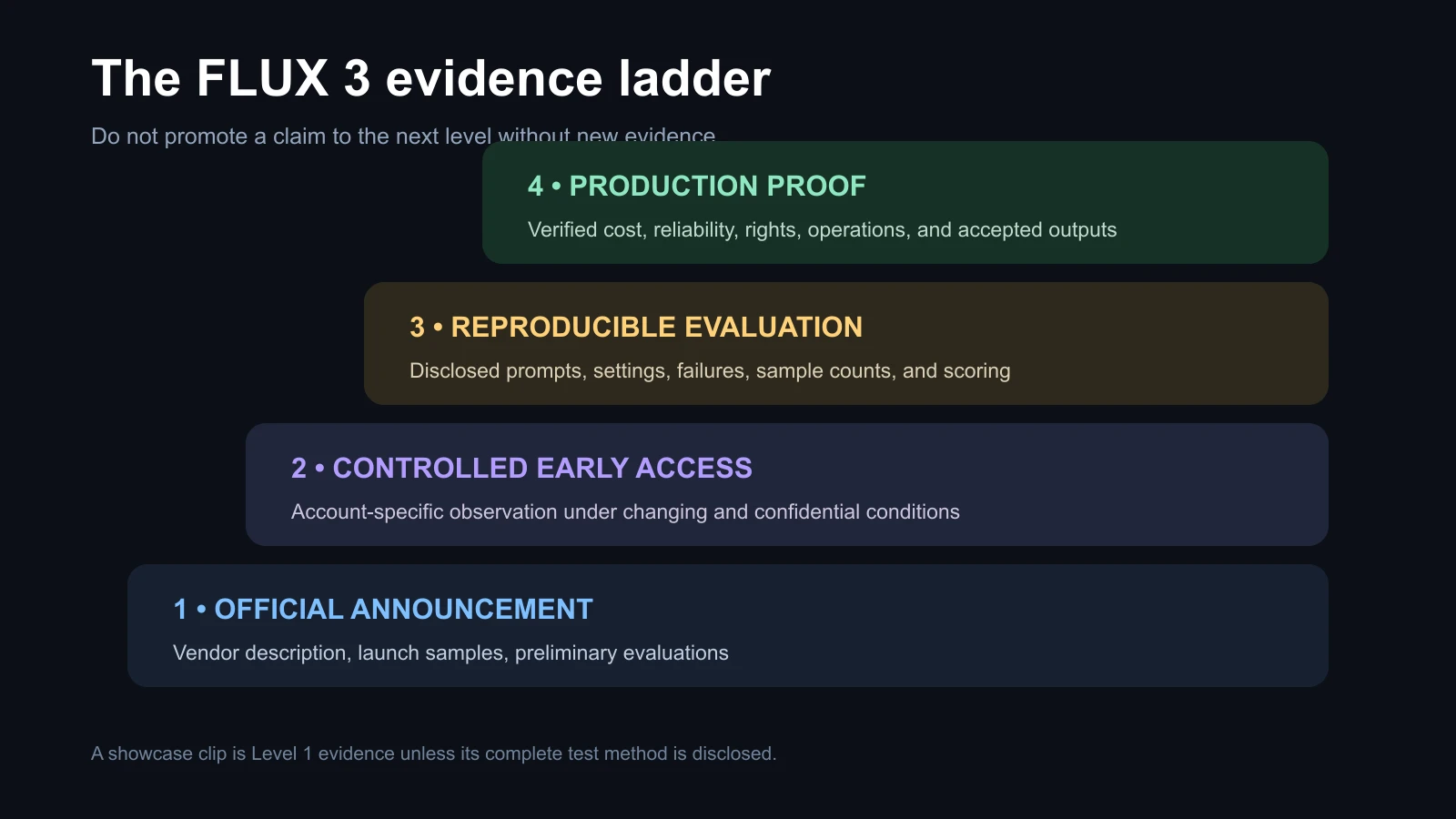
Start with a written claim matrix. For every statement, label it “officially announced,” “observed in our controlled access,” “independently reproduced,” or “production verified.” A FLUX 3 complete guide should never use a vendor sample as if it were an independent test. If you do not have Early Access, you can evaluate product fit and contract readiness, but not generation quality.
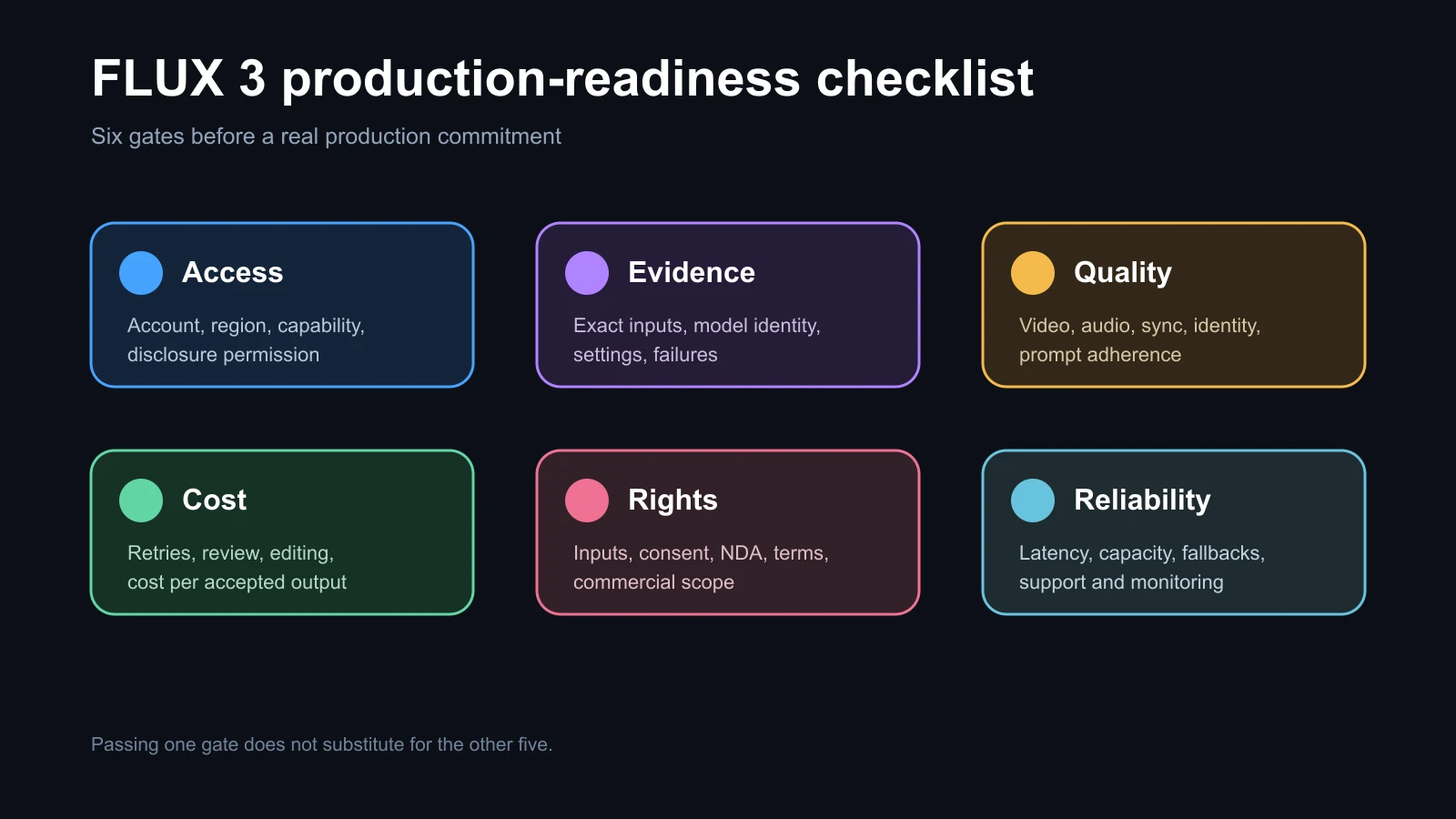
- Confirm access scope. Identify whether you have an invitation, which capability is enabled, which region and environment apply, and what may be disclosed.
- Freeze the test brief. Use real deliverable categories and objective acceptance criteria before seeing outputs.
- Record exact conditions. Preserve prompt, references, duration, aspect ratio, resolution, seed or controls if available, timestamp, retries, and returned model identity.
- Score audio and video separately. Check speech, ambience, impacts, continuity, temporal artifacts, identity, prompt adherence, and synchronization.
- Include failures. Report rejected generations, safety refusals, timeouts, unusable audio, and repair effort rather than selecting only the best samples.
- Calculate usable-output cost. Combine provider charges with retries, human review, editing, storage, and delivery work.
- Recheck before purchase. Early Access behavior, terms, endpoints, availability, and price can change quickly.
Is FLUX 3 available on Veemo AI?
No. The Veemo availability check in this FLUX 3 complete guide found that, on July 25, 2026, Veemo AI did not have a FLUX 3 catalog entry, registered generation form, provider route, pricing rule, or verified end-to-end generation path. Veemo AI therefore does not present a “Try FLUX 3” button, quote a Veemo price, or claim that its users can access the Early Access model.
If you need to produce video today, use a model that is visibly available in the Veemo AI generation form and verify its current settings before a paid project. The Veemo AI text-to-video workflow is a separate multi-model product route; linking it here does not imply FLUX 3 support. This article’s access statement must be updated only after a real catalog entry, provider integration, credit rule, form, and production generation have all been verified.
Final recommendation
The practical verdict of this FLUX 3 complete guide is to treat FLUX 3 as a serious but early multimodal platform, not as a generally available replacement for every image or video model. FLUX 3 Video has the clearest access path through a limited program and the strongest published capability detail. FLUX 3 Image, FLUX 3 Action, and FLUX 3 Dev remain at different announced or partner stages. Pricing and stable public API specifications are not yet available.
Apply for Early Access if native audiovisual generation, reference-driven video, multilingual dialogue, or multimodal research materially fits your roadmap and your team can accept confidentiality and changing specifications. For committed production work, keep an available fallback until your own account, terms, test set, and budget demonstrate readiness. Revisit this guide when BFL publishes image access, public prices, API documentation, model IDs, weights, or licenses.
Frequently asked questions
Is FLUX 3 publicly available?
As this FLUX 3 complete guide explains, FLUX 3 Video is offered through limited Early Access, not unrestricted general availability. BFL says FLUX 3 Image Early Access will open in the following weeks. Action access is partner-focused, and FLUX 3 Dev open weights are planned for later.
Can FLUX 3 generate video with sound?
BFL says FLUX 3 generates video with native audio and supports clips up to 20 seconds. It lists text, image, video, audio continuation, and keyframe inputs or workflows. Public production limits and pricing are not yet documented.
Is FLUX 3 an image generator?
BFL has shown image synthesis and editing and says FLUX 3 Image access will follow. At the evidence date, the company’s own wording does not establish an open, generally available image product.
How much does FLUX 3 cost?
No public FLUX 3 price appears in the current BFL pricing documentation. Early Access pricing and specifications may be confidential. Avoid estimates until BFL publishes a price or provides terms for your account.
Are FLUX 3 weights available?
No public FLUX 3 weights, license, inference requirements, or release date were verified. BFL plans an open-weight multimodal backbone called FLUX 3 Dev, but planned access is not current availability.
Can I use FLUX 3 outputs commercially?
Commercial rights depend on the exact Early Access or future service agreement. Do not apply FLUX.2 terms to FLUX 3. Review the controlling contract, input rights, confidentiality, usage policy, and output obligations with qualified counsel.
Can I use FLUX 3 on Veemo AI?
No verified FLUX 3 route is currently available on Veemo AI. Veemo’s existing video tools use other registered models. A direct FLUX 3 CTA should appear only after a real integration is production tested.